
Ergonomic design prevents injuries.
Muscle strains, back problems, shoulder injuries and hip problems are common hazards in aviation maintenance, but they can be reduced or avoided with better designed equipment — equipment that makes you feel you haven’t “crawled through a knot-hole backwards” to get the job done.
Ergonomic design is critical for safety, productivity, and long-term workforce health. In aviation maintenance, these structures directly influence how workers access equipment, perform tasks, and manage physical strain. Poor design can lead to fatigue, musculoskeletal disorders, lost-time injuries, and decreased efficiency. Thoughtful engineering, on the other hand, enhances safety, comfort, and overall job performance.
- Working height is one of the primary ergonomic challenges. Platforms must position workers at an optimal height relative to the task. If a platform is too low, workers are forced to reach overhead, straining shoulders, neck, and upper back. If too high, they may bend forward or work in awkward wrist angles. Ideally, work surfaces should allow tasks to be performed between mid-thigh and chest level, minimizing excessive reaching or stooping. Adjustable-height platforms offer flexibility and accommodate a wider range of tasks and worker statures.
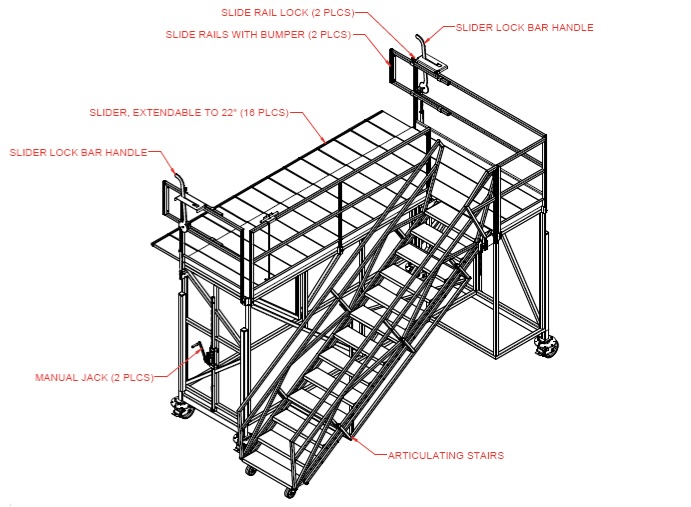
- Access and egress present important ergonomic considerations. Stairs should be designed with consistent rise and run dimensions, proper handrails, and slip-resistant treads. Steep or uneven steps increase the risk of trips and falls, particularly when workers are carrying tools or parts. Ladder access, while space-efficient, is generally less ergonomic and more hazardous than stairways, especially for frequent use. Properly angled stairs with adequate landing space significantly reduce fatigue and injury risk.
- Surface traction is another essential issue. Workstands are often used in environments where fluids such as oil, water, or hydraulic fluid are present. Non-slip surfaces, grated decking, and anti-skid coatings improve footing and reduce fall hazards. However, designers must balance traction with comfort; overly aggressive grating can cause foot discomfort during long periods of standing. Anti-fatigue matting or cushioned surfaces may help reduce lower back and leg strain during extended tasks.
- Reach distance and task layout also play a major role in ergonomic effectiveness. Tools, controls, and parts storage should be positioned within easy reach to prevent repetitive overextension. In aircraft maintenance settings, for example, platforms must allow technicians to access fuselage or engine components without twisting or leaning excessively over guardrails. Extended leaning increases lower back stress and compromises balance. Guardrail placement should protect workers without interfering with task access.
- Mobility and stability present another ergonomic tradeoff. Many workstands must be easily movable to support changing workflows. However, mobility introduces potential instability if locking mechanisms are inadequate. Casters should include reliable locking systems that prevent any movement during use. Excess vibration or sway can cause fatigue and reduce precision during detailed tasks. Stability is especially critical when workers handle heavy tools or perform torque-sensitive operations.
- Lighting integration is frequently overlooked in ergonomic design. Inadequate lighting forces workers into awkward positions to see clearly, contributing to neck and eye strain. Integrated LED lighting, adjustable light positioning, and minimized shadowing significantly improve posture and task accuracy. Similarly, noise and vibration control should be considered when platforms interface with powered equipment.
In summary, ergonomic design of workstands and platforms involves careful consideration of height, access, stability, reach, surface safety, lighting, and adaptability. When these factors are addressed holistically, organizations benefit from improved safety outcomes, higher productivity, and a healthier workforce.